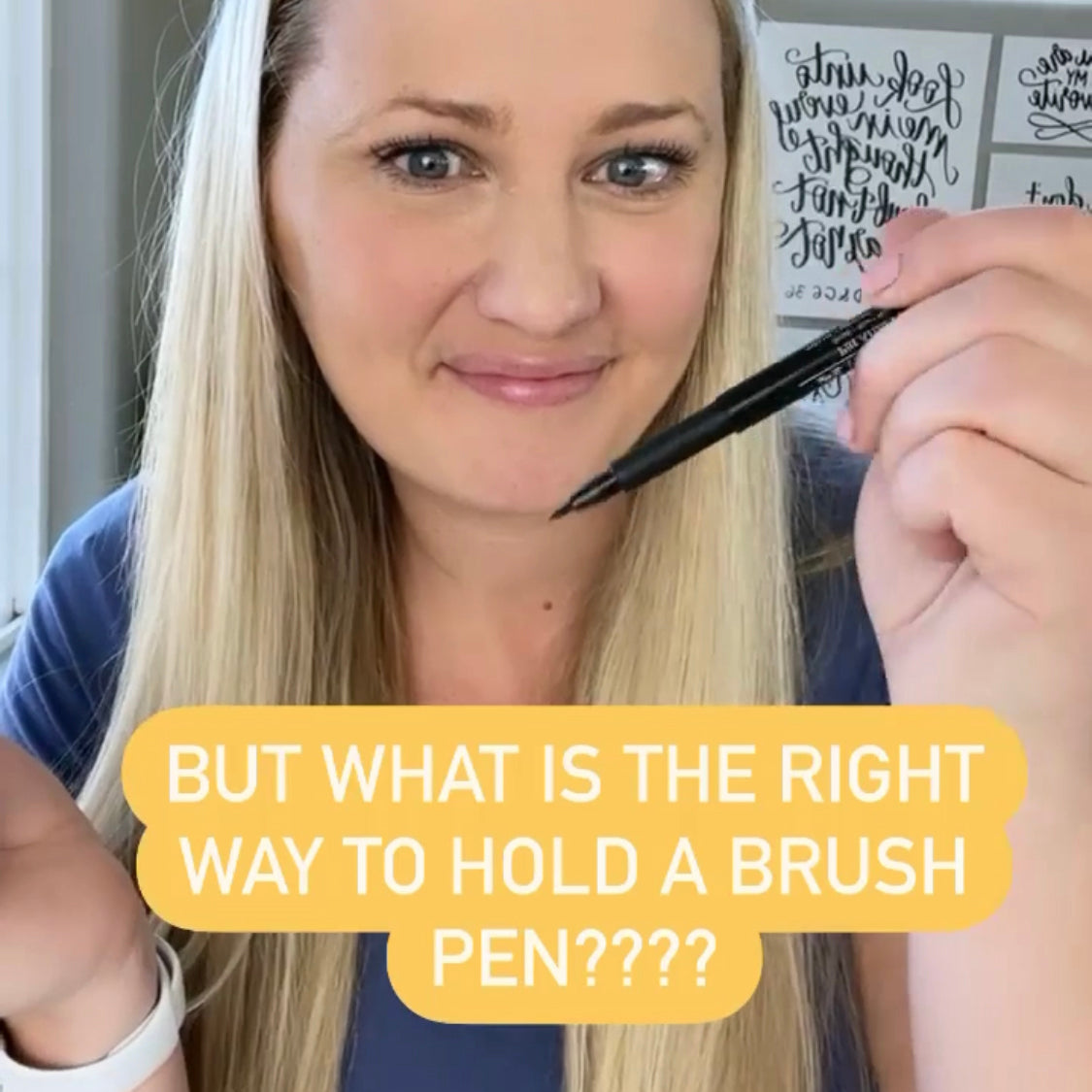
One of the biggest questions I get asked by people who are new to hand lettering is: "What's the right way to hold a brush pen?" (And its cousins: how do I hold a calligraphy pen? A marker?)
For modern lettering, your "calligraphy pen" is usually a brush pen or a marker, and that's what I teach and use every day. The truth is, there are a variety of grips that work well, but there's one thing you ALWAYS need to do with your brush pen: hold it at an angle!!
The quick answer
- Angle: hold your pen at about a 45 degree angle to the paper, never straight up and down.
- Height: grip it about 1.5 to 2 inches up from the tip.
- Grip: pointer finger on top, thumb on the side, and keep it relaxed. No death grip!
- Anchor: rest your pinky on the paper to steady your hand.
- Pressure: press down on downstrokes, go light on upstrokes.
I put together a quick video showing exactly how I hold my brush pen. Watch, or keep reading below:
How to hold a brush pen
Always hold it at an angle
When lettering with brush pens, you want to avoid fraying AT ALL COSTS!! If you hold your pen vertically, your brush tip will fray, which ages your pen and prevents you from getting clean lines while lettering. Trust me, you don't want to letter with a frayed brush pen!!
My rule of thumb is to ALWAYS hold your brush pen at a 45 degree angle, no matter what direction your strokes are going. Whether you are pulling your pen towards you or pushing it away from you, holding it at the same 45 degree angle will protect the tip of your pen, prevent it from fraying, and make your pen last longer!
Of course, using nice, high-quality paper protects your brush pens, too. Extend the life of your pens by holding them at an angle and only using them on smooth paper, like the lettering paper we sell in our shop.
Where to hold it
As far as WHERE to hold your pen, you want to use a grip that is comfortable for you. I place my pointer finger on top and thumb on the side, and hold it about 1.5 to 2 inches up from the nib.
I find that holding your brush pen at this height helps with control and range of strokes: if you hold your pen too close to the nib, it can be hard to make bigger strokes, but too far up can make it difficult to control.
Use your pinky to steady your hand
Another tip that helps me get smooth hand lettering: I always place my pinky down on the notebook or paper I'm using to help steady my hand. I've trained myself to use my pinky as part of my pen grip, which helps me make smooth and deliberate strokes.
I've seen lots of other artists, from lettering to watercolor painting, use this technique to steady their hands, and I highly recommend trying it!
Let pressure do the work
The thick and thin lines in brush calligraphy come from pressure, not from changing your grip. Press down as you pull the pen toward you (downstrokes) and lighten up as you go up (upstrokes). Keep the same grip and angle the whole time.
How to hold a calligraphy marker
Markers and fineliners have firm tips, so they're much more forgiving than brush pens. Hold them the way you'd hold a regular pen, at a comfortable angle, with the same relaxed grip and pinky anchor.
With a marker you won't get thick and thin lines from pressure. Instead you create the calligraphy look with faux calligraphy: write your word, then go back and thicken every downstroke by hand. Here's my full tutorial on using markers for faux calligraphy.
In between a marker and a big brush pen? A small, firm brush pen like the Fudenosuke hard tip is a great first brush pen. Hold it exactly like a brush pen, at an angle, but it's much easier to control.
Common pen grip mistakes
- Holding the pen straight up and down. This is the #1 reason brush tips fray.
- Squeezing too hard. A death grip makes your lines shaky and tires your hand fast. Relax your fingers!
- Holding too close to the tip. You'll have a hard time making bigger strokes.
- Floating your hand. Without your pinky or the side of your hand on the paper, it's hard to make smooth, steady lines.
- Pressing on the upstrokes. Save your pressure for the downstrokes, which is where the thick lines go.
Tips for lefties
And for all my Lefties out there... these tips apply to you too! Hold your pen at a 45 degree angle, use a grip that's comfortable for you, and try using your pinky finger to steady your hand. I have a whole post of tips for lefty lettering, including how to avoid smudging.
Frequently asked questions
What angle should I hold a brush pen at?
About 45 degrees to the paper, and keep that same angle whether you're pulling the pen toward you or pushing it away.
Why is my brush pen fraying?
Usually it's from holding the pen too upright, pressing hard on upstrokes, or using rough paper like printer paper. Hold it at an angle and use smooth lettering paper and your pens will last much longer.
How do you hold a pen for calligraphy?
Hold it like a regular pen with a relaxed grip, about 1.5 to 2 inches from the tip, tilted at an angle, with your pinky resting on the page. Then let pressure (or for markers, thickening the downstrokes) create the calligraphy look.
Do I need to change my grip for different strokes?
No! Keep the same grip and angle the whole time. Only your pressure changes.
Ready to practice?
If you want me to walk you through it stroke by stroke, my Beginning with Brush Pens course covers pen grip, pressure and every stroke you need. Not sure where to start? Here's my guide to the best online lettering courses for beginners.
Need pens? My Lettering Pen Starter Set is a handpicked set of my favorite pens for beginners. You can find more pen tips on my Instagram, too!
Xo - Lisa